
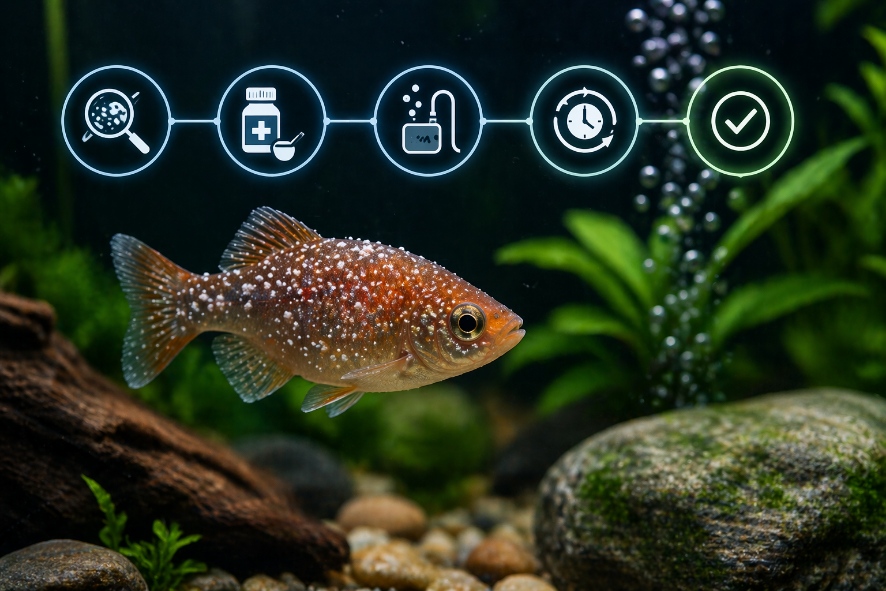
Ich (White Spot Disease) outbreaks escalate fast. Speed and consistency matter more than switching products repeatedly. Pick one proven protocol and run it correctly from start to finish.
This guide provides a clear, day-by-day framework to treat Ich effectively while minimising fish stress.
Why Consistency Beats "Miracle Cures"
Many treatments fail not because the medication is weak, but because hobbyists:
Stop treatment as soon as white spots disappear
Switch products mid-course
Forget to increase aeration
Ignore water quality during treatment
Ich has a complex lifecycle. Only the free-swimming stage (theronts) is vulnerable to most medications. Stopping early leaves the parasite in its protected trophont (on fish) or tomont (on surfaces) stage, leading to rapid reinfection.
Daily Treatment Timeline
| Day | Action | Why It Matters |
|---|---|---|
| Day 1 | Confirm symptoms (white spots like salt grains, flashing, clamped fins). Test ammonia, nitrite, nitrate, and pH. | Ich can be confused with epistylis or fungal infections. Poor water quality makes treatment less effective. |
| Days 1–3 | Start treatment at full label dosage. Increase aeration significantly (add air stone or raise filter output). Remove activated carbon. | Medication reduces dissolved oxygen. Ich-infected fish already have damaged gills. |
| Days 4–7 | Continue medication exactly as scheduled. Do not skip doses. Monitor appetite and stress signs daily. | The lifecycle continues. Missing a dose resets progress. |
| Days 8–10 | Maintain full treatment schedule. Perform water changes only if ammonia/nitrite rise, then redose medication based on water removed. | Ich tomonts can take up to 10 days to hatch at lower temperatures. |
| Post-visible phase (Days 11–17) | Continue treatment for the full recommended duration (check product label – often 5–7 days AFTER last spot disappears). | Stopping when spots fade causes reinfection in 90% of cases. |
Important: Some treatments (e.g., copper-based for marine) require different durations. Always read your specific product label.
Support Care During Treatment
| Support Action | Why It Helps |
|---|---|
| Keep temperature stable (or raise slowly to 28–30°C for freshwater) | Higher temperature accelerates Ich lifecycle, making it vulnerable faster. But raise slowly – 1°C per day max. |
| Avoid major tank rescapes | Reduces stress and prevents tomonts from being disturbed into premature release. |
| Maintain stable oxygenation | Medication + heat + gill damage = high risk of oxygen starvation. |
| Feed lightly with high-quality food | Poor appetite is normal, but avoid polluting water with uneaten food. |
| Remove carbon and UV steriliser | Both remove medication from the water column. |
Temperature caution: Not all fish tolerate high temperatures. Research your species before raising above 28°C.
Relapse Prevention (Most Important Section)
Ich relapses happen because the parasite's tomont stage can survive for days on substrate, decor, or filter media.
To prevent reinfection:
| Rule | Action |
|---|---|
| Finish the full course | Even if spots vanish on Day 5, treat for the full label duration (often 7–10 days total). |
| Observe after treatment | Watch fish closely for at least 7 days post-treatment before declaring success. |
| Quarantine new arrivals | Ich often enters via new fish or plants. A 2–4 week quarantine prevents repeat outbreaks. |
| Sterilise equipment | Nets, buckets, and siphons used during outbreak should be disinfected or dried completely for 48 hours. |
Common mistake: Seeing no spots on Day 6 and stopping treatment. By Day 10, new spots appear. You're now back to Day 1.
When to Consider Changing Treatment
Do not switch products unless you see:
No improvement after 7–10 days of correct dosing
Severe adverse reaction in fish (e.g., gasping at surface, erratic swimming)
Confirmed medication resistance (rare but possible with formalin/malachite green)
If you must switch: Run activated carbon for 24 hours to remove the first medication, perform a 30% water change, then begin the new product from Day 1.
Freshwater vs Marine Ich
| Type | Pathogen | Key Treatment Difference |
|---|---|---|
| Freshwater Ich | Ichthyophthirius multifiliis | Heat + salt + formalin/malachite green often effective |
| Marine Ich (White Spot) | Cryptocaryon irritans | Copper-based treatments or hyposalinity. Heat alone won't work. |
Marine note: Never use formalin/malachite green products in a reef tank with invertebrates. Move infected fish to a separate quarantine system.
Quick Reference Summary
Confirm Ich (white spots + flashing + poor water quality)
Increase aeration before adding medication
Remove carbon and UV – they absorb medication
Dose exactly as label says – no skipping
Treat for full duration – including 5–7 days after last spot
Observe for one week before declaring victory
A properly completed treatment course – even with a basic medication – is far more effective than switching between three "stronger" products without finishing any of them.