
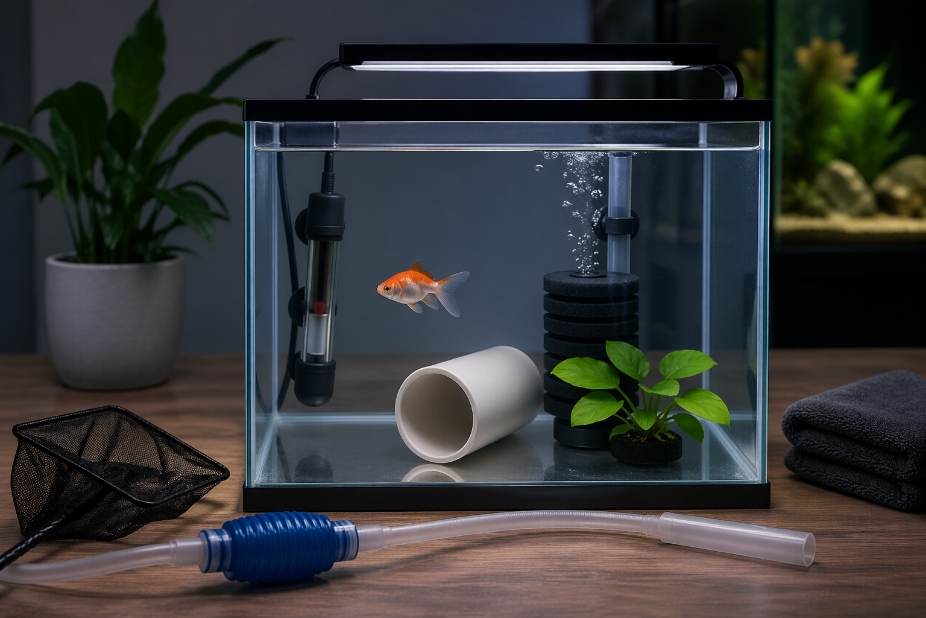
Quarantining new or sick fish is the single most effective way to prevent parasites, bacterial infections, and viral outbreaks from entering your main aquarium. Yet many hobbyists skip this step, believing it's too complicated or expensive.
The truth: A basic quarantine setup costs far less than treating a full display tank. Below is a practical, UK-friendly guide to building a quarantine system on a budget — in one day.
Why Quarantine Matters (Even on a Budget)
Treating diseases in a main display tank often means: medicating all fish (including healthy ones), damaging beneficial bacteria and invertebrates, removing activated carbon, and risking a tank crash. A dedicated quarantine tank isolates the problem, saves money, and preserves your display ecosystem.
Minimum Equipment List (Budget Version)
You don't need a second full-scale setup. Here's what works:
| Equipment | Budget Option | Why It's Needed |
|---|---|---|
| Tank | 20–40L plastic storage bin or second-hand glass tank (bare-bottom) | Easy cleaning; prevents pathogen hiding spots |
| Heater | 50W adjustable heater (used, tested) | Stable temperature (24–26°C for tropicals) |
| Thermometer | LCD strip or glass floating type | Monitor daily swings |
| Filtration | Sponge filter + air pump | Biological & gentle mechanical filtration |
| Hiding spots | PVC pipe offcuts or clean ceramic pots | Reduces fish stress |
| Dedicated tools | Net, siphon, buckets (clearly labelled) | Prevents cross-contamination |
Estimated total cost: £25–40 (excluding pump if you already own one).
Pro tip: Ask your local fish store for spare sponge filter media – they often give it away for free.
Step-by-Step Setup in 24 Hours
Phase 1: Preparation (Hours 0–2)
Clean the tank/bin using hot water only (no soap or chemical cleaners).
Install heater and sponge filter – set heater to match your display tank temperature.
Add dechlorinated water using a tap water conditioner (e.g., Seachem Prime or API Tap Water Conditioner).
Phase 2: Quick Bio-Filtration (Hours 2–6)
A quarantine tank needs an instant biological filter. Do not run it without a bio-source.
Two safe methods:
Method A (fastest): Squeeze dirt from an established display tank sponge filter into the quarantine tank water.
Method B: Place a small piece of mature filter media inside the quarantine sponge filter.
Warning: Never move filter media from a tank showing signs of disease.
Phase 3: Acclimation & Observation (Hours 6–24)
Add fish only after temperature and dechlorination are confirmed.
Observe for 24–48 hours before any treatment.
Feed very lightly – excess food spikes ammonia fast.
How to Run the Quarantine Tank Safely
Small water volumes change rapidly. Follow these rules:
| Task | Frequency |
|---|---|
| Test ammonia & nitrite | Every 12–24 hours |
| Partial water change (25–30%) | As soon as ammonia rises above 0.25 ppm |
| Record behaviour (eating, breathing, flashing) | Daily, same time each day |
| Disinfect tools after each use | Immediately (bleach solution then rinse thoroughly) |
Biosecurity Rules That Actually Work
Cross-contamination is the #1 reason quarantine fails. Follow these strictly:
No shared equipment – Nets, siphons, buckets, and hoses stay with quarantine only.
Always wash hands – Between touching quarantine and display tanks.
Use separate water change hoses – Or sterilise with 10% bleach (followed by heavy dechlorination).
Never pour quarantine water into a display tank.
If you only remember one thing from this guide: treat every quarantine item as potentially infectious.
When to Move Fish to the Main Tank
A standard observation period is 2–4 weeks. Move fish earlier only if:
The fish was a healthy-looking specimen from a trusted source and
No symptoms appeared during 14 days and
Ammonia/nitrite remained at zero with stable temperature.
Gradual transfer method:
Turn off display tank lights.
Use a dedicated container to move the fish (no net if possible).
Release after floating for 10 minutes to match temperature.
Final Summary
| Rule | Why It Matters |
|---|---|
| Use a 20–40L bare tank or bin | Easy to clean and disinfect |
| Sponge filter + heater are essential | Provides bio-filtration and stable temperature |
| Seed bio-filtration from a healthy tank | Avoids ammonia spikes |
| Test water daily | Small volumes swing fast |
| Never share equipment between tanks | Prevents cross-contamination |
A £30 quarantine setup today prevents £300+ in treatment costs – and fish loss – tomorrow.